

For the past few years, the SEO industry has been chasing a ghost.
Ever since Google introduced AI Overviews (and subsequent features like AI Mode), digital marketers have been flying mostly blind. We knew our content was being pulled into these generative answers. We noticed the spikes in brand awareness. But measuring it? That was a completely different story.
Until now.
Google has officially started rolling out dedicated Search Generative AI performance reports inside Google Search Console (GSC). Currently being tested with a select group of website owners in the UK before a global rollout, this update introduces entirely new data designed specifically for the AI era.
Given how vague Google has been about AI performance until now, this is huge. Here is everything you need to know about the new metrics, the hidden traps, and how to use this data to claim your share of voice in AI Search.
What’s Inside the New GSC Generative AI Report?
When the update hits your profile, you will find a dedicated Generative AI section nested cleanly under your standard Performance tab.
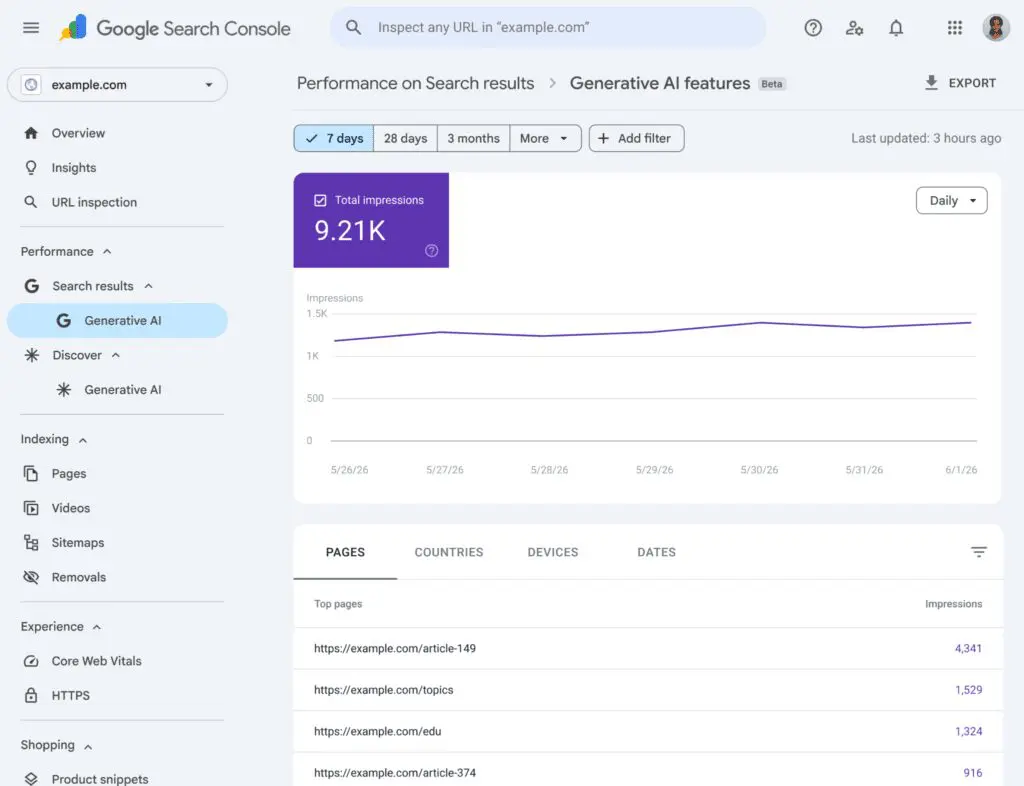
This report isolates how your content performs exclusively within Google’s AI ecosystems, including AI Overviews, AI Mode, and AI-driven elements within Google Discover.
The data can be sliced and diced down to an hourly level using several core filters:
- Pages: The exact URLs Google’s models are using to ground their responses.
- Countries & Devices: Where and how users are triggering these AI experiences.
- Dates: Deep temporal tracking to see how core algorithm updates change your AI footprint.
Knowing exactly which pages Google considers an authoritative “preferred source” for its LLM (Large Language Model) is a massive win. But as with any major Google update, there is a catch.
The Measurement Gap We Still Need to Solve
While the SEO community is celebrating the arrival of this data, we have to look closely at what is actually being provided.
Google’s new report gives us Impressions, but it omits Clicks and Query-level data.
This means you can see exactly how often your page was displayed inside an AI Overview, but you cannot see how many people clicked that link to visit your site, nor can you see the exact conversational prompt that triggered it.
Why the restriction?
This partial data release is largely driven by regulatory pressure. The Competition and Markets Authority (CMA) in the UK has been pushing Google for greater transparency and fair attribution for publishers. Giving us impressions and a clear view of our links is a step toward compliance, but it leaves businesses with a major attribution puzzle.
Without click data, standard SEO metrics fall short. If you don’t know how to cross-reference AI impressions against your actual organic traffic, it’s easy to waste time optimising the wrong pages.
The New “Opt-Out” Toggle: Why You Should Ignore It
Alongside the reporting suite, Google is testing a new dashboard toggle that allows webmasters to choose whether their content can be used to ground generative AI features.
Circulate’s Take: Unless you have highly proprietary data that you are actively protecting from all LLMs, do not turn this toggle off.
In the modern search landscape, opting out of AI Overviews and AI Mode is essentially opting out of search entirely. If your business isn’t there to ground the answer, your competitor’s business will be. If the AI is currently pulling incorrect details about your brand, the solution isn’t to hide; it’s to fix your digital footprint so the models understand your entity flawlessly.
How to Turn AI Impressions Into Real Revenue
So, how do we use a report that shows impressions but no clicks? We bridge the gap using smart analysis.
When your site gains access to the new reports, our strategy centres on three execution steps:
Identify the AI entry points: We isolate the specific URLs on your site that are generating massive AI impressions. These are the pages Google already trusts fundamentally to answer complex, conversational queries.
Cross-Reference traditional click data: By mapping your high-impression AI pages against your standard organic click data over identical timeframes, we can reverse-engineer your true AI click-through rates and traffic patterns.
Optimise and expand: If a page has massive AI impressions but low overall clicks, it means the AI summary is satisfying the user completely (a “zero-click” result). We fix this by transforming your page into a deeper asset, adding original data, proprietary graphics, expert analysis, and interactive tools that give the user a clear reason to click through and explore beyond the basic AI summary.
Win the Era of AI Search
The launch of these dedicated reports proves that AI Search isn’t a temporary test, it is the foundation of how Google operates. Standing out in this landscape requires a shift from old-school keyword stuffing to advanced entity optimisation, structured brand authority, and deep technical alignment.
At Circulate, we specialise in helping brands decode these algorithmic changes. Whether you need to fix your technical foundations, optimise your content to become a preferred AI source, or build a data-driven framework to track your ROI, we are here to guide you.
Ready to capture your share of voice in AI Overviews?
- Explore our comprehensive AI Search Services to see how we position your brand for generative search.
- Get a transparent look at your current digital footprint with our Brutally Honest Free SEO Audit.
- Get in touch with the Circulate team today to book a strategy session and future-proof your search traffic.